In 2024, the Packaging and Packaging Waste Regulation (PPWR) was adopted as part of the European Green Deal. The regulation represents a major step towards the Green Deal’s central objective: making Europe climate neutral by 2050 (European Green Deal Policy Guide).The PPWR will address packaging waste at European level and establish harmonised legislation across all EU Member States. In future, the responsibility for introducing packaging-related environmental legislation will no longer rest solely with individual countries. Instead, binding obligations and standards will be defined at EU level.
As the term “packaging” covers a broad range of products and industries, a significant number of businesses will be affected by the new regulation. Any company involved in manufacturing, transporting or marketing packaging or packaged goods must comply with the PPWR (PPWR: All deadlines & dates of the EU Packaging Regulation). Key areas include packaging design and labelling requirements.
As parts of the regulation will come into force as early as August 2026, it is advisable not to wait any longer and to find out immediately where action is needed in your own company. Our blog article is intended as a starting point and explains the most important points in a concise and understandable way. This will ensure that you are well prepared for the implementation of the PPWR.
- 1. The most important objectives
- 2. Producers, manufacturers, suppliers: Who has to do what?
- 3. The most important deadlines up to 2030
- 4. What must a declaration of conformity contain?
- 5. What will change specifically for packaging
- 6. Conclusion & recommendations for action: How to make your packaging PPWR-ready
- 7. More information
…
The Most Important Objectives of the PPWR
To ensure a consistent approach across the European Union, the PPWR aims to establish harmonised packaging legislation throughout all Member States. Until now, packaging laws have been implemented at national level (Packaging and Packaging Waste Regulation [PPWR] New EU Packaging Regulation), resulting in differing regulations and standards across Europe.The harmonisation of laws serves to implement the EU’s climate targets more quickly and efficiently.
The PPWR focuses on three main objectives: climate neutrality, the promotion of a circular economy and waste prevention. To support these goals, the EU is introducing measures designed to improve the recyclability and reusability of packaging while significantly reducing the overall amount of packaging waste generated (EU Packaging Regulation [PPWR]).

To support these ambitious objectives, the PPWR introduces clear requirements for labelling, recyclability, reusability, packaging minimisation and recycled content. These harmonised standards are intended to encourage consistent implementation across all EU Member States and accelerate the transition towards a circular economy.
…
Producers, Manufacturers, Suppliers: Who Has to Do What?
The PPWR adopts a holistic approach that places responsibility on all parties throughout the supply chain. It is therefore essential for businesses to understand their specific role within this chain, as each stakeholder will be subject to different obligations under the regulation. Only by clearly identifying these responsibilities can the appropriate measures be taken to ensure future PPWR-compliance. The main stakeholders defined within the PPWR are producers, manufacturers, suppliers and importers. Each of these groups has distinct roles and responsibilities that must be fulfilled under the new regulation.
Producers are companies that manufacture and place packaging or packaged products on the market. They are responsible for ensuring and demonstrating that their packaging complies with the requirements of the PPWR. Manufacturers, by contrast, are defined as companies that sell packaging and packaged products.
Manufacturers are also subject to what is known as Extended Producer Responsibility (EPR). This means they are required to take responsibility for the products they place on the market throughout their entire lifecycle, from product design through to disposal and recycling (PPWR: All deadlines & dates of the EU Packaging Regulation).
Suppliers are – who would have thought – responsible for delivering or supplying products and materials. Material suppliers may be required to provide information that enables producers to demonstrate PPWR-compliance. In this context, the obligation to provide the necessary information lies with the supplier. In future, importers must also ensure that all imported products fully comply with PPWR requirements (EU Packaging Regulation [PPWR]).
…
…
What Must a Declaration of Conformity Contain?
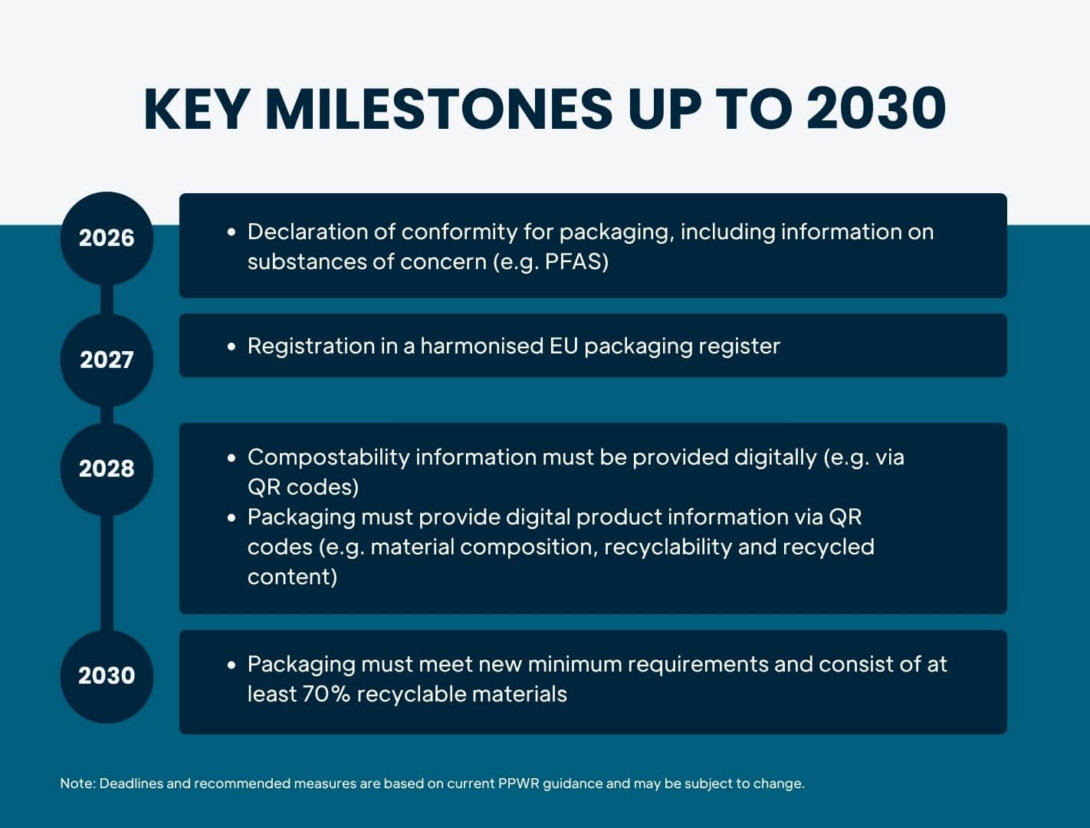
From 2026 onwards, producers will have to draw up a declaration proving that their packaging complies with the PPWR. This document is referred to as a Declaration of Conformity. At present, not all requirements have been fully defined, as certain provisions of the regulation will only come into force from 2030 onwards. However, from August 2026, businesses must confirm whether their packaging contains hazardous substances, including PFAS (per- and polyfluoroalkyl substances).
The Declaration of Conformity must contain the following:
- Name and address of the producer
- Description of the product
- Declaration of conformity
- Details of the notified body, where applicable
- Reference to the conformity assessment procedures applied
As the PPWR is being introduced gradually, additional documentation and evidence requirements will be clarified over time (PPWR: All deadlines & dates of the EU Packaging Regulation).
…
What Will Change Specifically for Packaging
The PPWR places particular emphasis on recycling, compostability and minimisation. To improve recycling rates for single-use packaging, all Member States will be required to introduce return and collection systems comparable to existing deposit return schemes, such as the German DPG system or the Dutch statiegeld.
In addition, by 2030, packaging will need to meet minimum recyclability requirements, with many materials expected to achieve at least 70% recyclability. However, these minimum values will not be implemented overnight, but will be increased gradually to allow all stakeholders sufficient time to adapt. Transitional arrangements will also apply. For example, packaging that does not yet meet the minimum recyclability thresholds may still be placed on the market until 2035.
Recycling: The proportion of recycled material used in plastics plays a major role in the PPWR. This refers to the amount of recycled content contained within plastic packaging. To support this objective, the EU has introduced clear recycled-content targets.
From 2030, contact-sensitive packaging must contain between 30% and 35% recycled material, depending on the material type. By 2040, these targets will increase to as much as 65%.
Compostability: Labels affixed directly to fruit and vegetables as so-called primary packaging must, in future, be not only food-safe but also compostable. Some label materials already meet industrial composting standards. However, this will no longer be sufficient from 2028 onwards. By then, these materials must also be fully decomposable in ordinary household compost.
Minimisation: The PPWR also places strong emphasis on reducing the amount of packaging material used. As a result, reducing both the volume and weight of packaging will become increasingly important across all packaging types.
This is expected to create a number of challenges, particularly for transport packaging. It will also have implications for label printing and material selection. Some material manufacturers are already working o
…
Conclusion & Recommendations for Action: How to Make Your Packaging PPWR-Ready
The PPWR will require many companies to thoroughly review and adapt their existing processes. To ensure future PPWR-compliance, businesses should begin taking practical measures at an early stage, including reviewing supply chains to ensure that all parties involved fulfil their respective obligations under the regulation. Companies should also assess whether their current packaging materials remain compliant, as both the size and composition of packaging materials will play a decisive role in the future. From 2028, the PPWR will also require important material information to be provided via QR codes. Businesses should therefore ensure in good time that they have the necessary technical infrastructure in place to support these digital labelling requirements.
To help you navigate these upcoming changes, we have compiled a checklist covering the most important PPWR requirements and recommendations for action. You can download the checklist here:
…
More Information
It is well worth reviewing the official sources for more detailed information about the PPWR and its implementation. There you will find comprehensive guidance on the regulation and its future requirements.
Sources:
European Union. Regulation (EU) 2025/40 of the European Parliament and of the Council of 19 December 2024 on packaging and packaging waste, amending Regulation (EU) 2019/1020 and Directive (EU) 2019/904, and repealing Directive 94/62/EC (Text with EEA relevance). OJ L, 2025/40, 22 Jan. 2025. EUR-Lex, https://eur-lex.europa.eu/eli/reg/2025/40/oj. Accessed 11 Feb. 2026.
“EU-Verpackungsverordnung (PPWR).” IHK Schleswig-Holstein, 21 Feb. 2025, www.ihk.de/schleswig-holstein/innovation/umwelt/abfallberatung/eu-verpackungsverordnung
“Packaging and Packaging Waste Regulation (PPWR).” Veolia Deutschland, www.veolia.de/ppwr. Accessed 11 Feb. 2026.
“PPWR: Alle Fristen & Termine Der EU-Verpackungsverordnung.” Prodinger, Prodinger Organisation GmbH & Co. KG, www.prodinger.de/ppwr#accordion-panel-3466. Accessed 11 Feb. 2026
KPMG International. European Green Deal Policy Guide: Focus on “Fit for 55 Package”. Jan. 2022. https://assets.kpmg.com/content/dam/kpmg/xx/pdf/2022/01/green-deal-policy-guide-web-2022.pdf

Katharina Crusius-Brunner
Marketing