Storytelling in the Label Industry
Visual storytelling has been a growing trend in the label industry for several years. Storytelling itself is not new, people have been using stories for millennia to explain complex ideas or convey abstract concepts. Because this cultural practice has lasted so long, it is worth asking why and what makes it through labels so special.
What is Visual Storytelling?
Visual storytelling is the practice of communicating through images, which has generally proven to be very effective. It is used across a wide range of fields, including advertising, marketing, PR and corporate communications, showing that storytelling is not just a trend but a well-established cultural practice. The label industry has fully embraced this approach, and it is no longer a secret. At label.co.uk, we see that labels are increasingly being used to tell small, engaging stories that connect with consumers.
Historical and Literary References
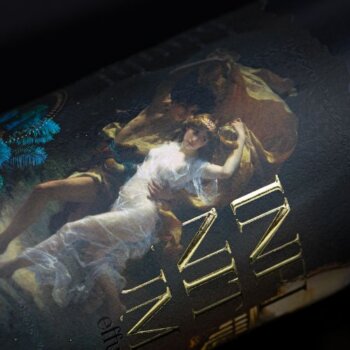
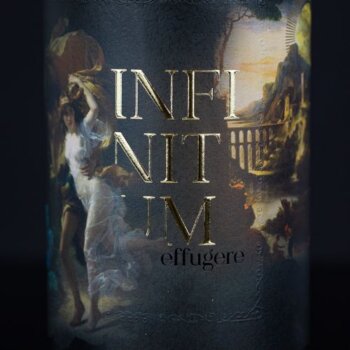
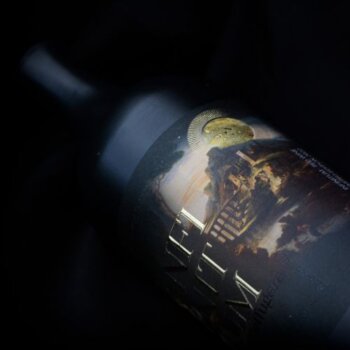
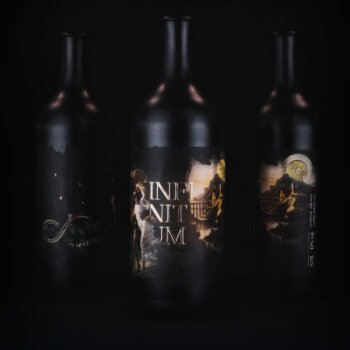
The label featured in this article, Infinitum Effugere, was entirely designed by us as part of a fictional concept. It earned third place in the “Label Printer of the Year” category at the Druck&Medien Awards in Berlin in 2022. The design tells the story of a young couple on the run, with light and darkness, the familiar and the unknown, at the heart of the narrative.
 In the mist of darkness, a young couple moves from the light into the unknown. They have no idea that they are passing through an invisible door, a threshold from which there is no turning back. From that moment, their world becomes darker and more chaotic. The edge of the label takes on a unique shape, the left-hand side transforming into a dark, mysterious forest, with the only sources of light being the golden fireflies and the Latin, embossed text from De rerum natura (On the Nature of Things) by the Roman poet and philosopher Lucretius.
Emir Ramic, designer of the label
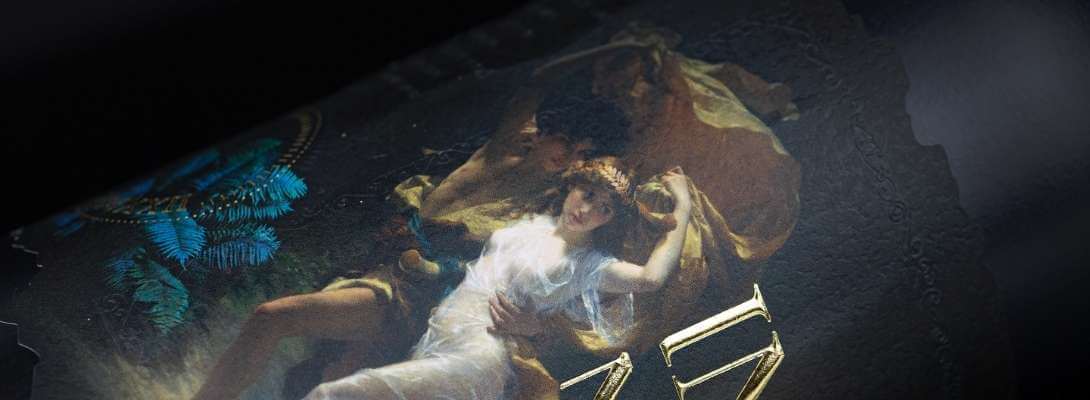
Using the figures, landscape, and carefully selected details, the label creates its own world, leaving room for interpretation. When observed closely, several questions arise: What is the couple fleeing from? Where have they come from, and where are they headed? To answer these, one can draw not only on the designer’s perspective but also on references from literature and art.
The couple shown on the label is taken from the French painting “The Storm” by Pierre Auguste Cot, completed in 1880. It is thought that the artist was inspired by the French novel “Paul et Virginie” by Bernardin de Saint-Pierre, in which the two characters take shelter from a sudden shower, using the heroine’s overskirt as an improvised umbrella. The ancient Greek romance “Daphnis and Chloe” by Longus may also have influenced the painting (The Metropolitan Museum of Art, a).
The section depicting the castle and aqueduct comes from the French painting “Evening: Landscape with Aqueduct” by Théodore Géricault, painted in 1818. Géricault visited Italy between 1816 and 1817 and later created depictions of Italian ruins in Paris based on these experiences (The Metropolitan Museum of Art, b).
There are many more details to discover, but each viewer is encouraged to explore and interpret them for themselves. We hope the label sparks engaging conversations. It can be seen as an ode to the artists of past eras, whose work should not only be found in museums but accessible everywhere, for everyone.
Emir Ramic, designer of the label
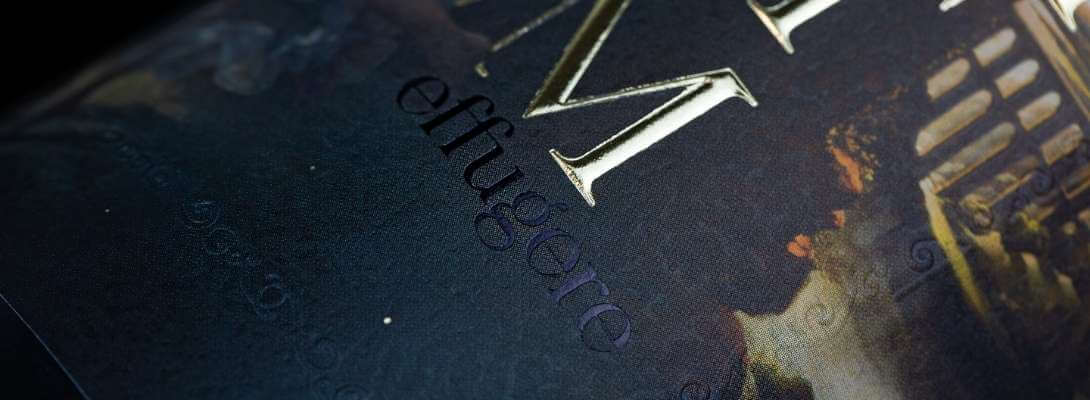
Some questions are meant to remain unanswered, giving viewers the freedom to bring their own ideas to the label. Missing information or deliberate omissions allow each person to complete the imagery in their own way. The label sparks countless associations and memories, drawing the viewer into the world it depicts.
Looking for a creative, impactful design for your own products? With our professional design service, your labels get a unique, standout design that captures attention and reflects your brand’s personality.
The Strengths of Storytelling, Simply Explained
Why is this label and its storytelling so effective? To answer that, let’s take a closer look at visual storytelling.
#1 Tension: A good story usually consists of a starting point, a problem and a resolution. On the label, tension is created through open questions, emotional conflicts and selective information. Viewers become curious and want to know how the narrative unfolds.
#2 Associations: Whether through mythological tales, historical events or familiar stereotypes, what we recognise on a label makes us pause. At the same time, it is very likely to trigger memories and emotions, increasing the chance that people will engage with the label’s content.
#3 Emotions: Heroes, lovers and villains. When we identify with the characters in a story, we experience it emotionally. What moves us shapes our thinking, which we naturally want to share. This is what makes the narrative linger in the mind.
Storytelling can influence human behaviour, convey knowledge and entertain (Radü, 2019, 79). This makes it a particularly powerful tool when applied to labels. Labels with storytelling elements capture attention, bring a brand to life and remain memorable.
Labels, Storytelling and QR Codes
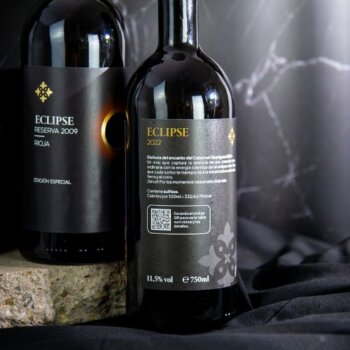
When printed QR codes are scanned with a smartphone, they provide online access to information such as images, videos or interactive content. Thanks to digital printing, QR codes can be added to your labels at label.co.uk quickly and cost-effectively. This way, the story doesn’t end on the label but continues online, where the possibilities are almost limitless. Visual storytelling on labels with QR codes thus has the potential to become a truly multimodal experience.
As a modern online printing company, we stay up to date with trends and innovations, and we are happy to inspire and advise you. Questions? You can reach us by telephone on +44 (0) 203 588 1080 or by email: info@label.co.uk.
Sources
Radü, J. (2019). New Digital Storytelling: Anspruch, Nutzung und Qualität von Multimedia-Geschichten. Nomos. doi.org/10.5771/9783845299273-25
Wikipedia (2026, 02. Feb.). Artikelseite Storytelling (Methode). Abgerufen am 18. März 2026 von https://de.wikipedia.org/wiki/Storytelling_(Methode)
The Metropolitan Museum of Art (a). The Storm. https://www.metmuseum.org/art/collection/search/435997
The Metropolitan Museum of Art (b). Evening: Landscape with an Aqueduct. https://www.metmuseum.org/art/collection/search/436455

Updated by Laura Münker
Marketing