
Roll configuration in a few steps
Roll labels are generally applied mechanically, meaning they are dispensed and applied to products using a labelling machine. For this reason, it is important to understand the requirements of the machine that will process the rolls.
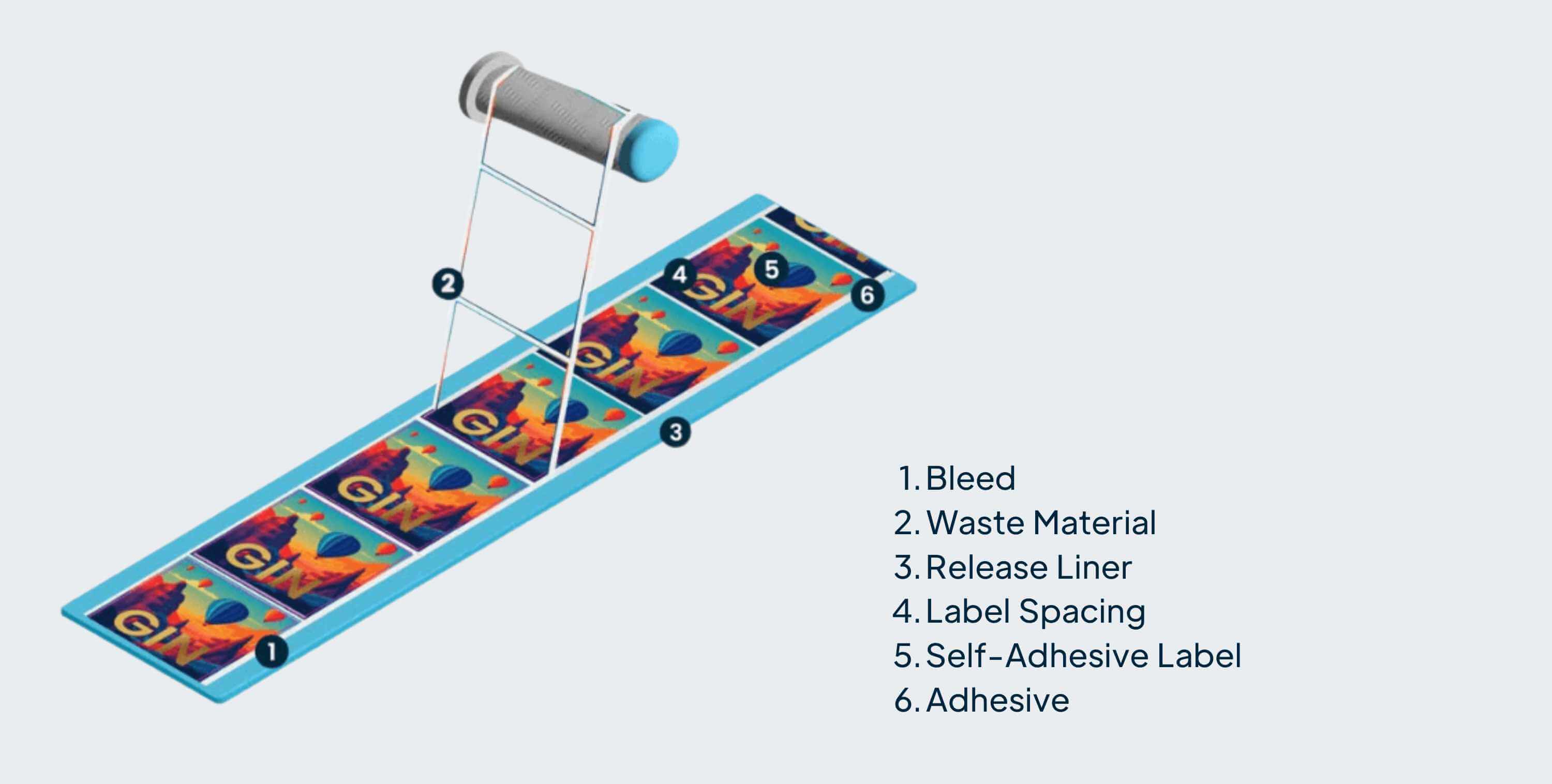
The following elements must be taken into consideration:
Outer Diameter
You can specify either the roll diameter or the number of labels per roll.
The maximum roll diameter is important to ensure that the roll fits your labelling equipment during application. If no specific requirements are provided, rolls are produced according to ecological and economical considerations.
Core Size
The standard core size we offer is 76 mm (inner diameter), but we also offer core sizes of 40mm and 25mm . Selecting the correct core size is particularly important for machine application, as the requirements depend on the specifications of your equipment. For manual application, this information is generally not relevant.
Winding Direction
If your roll labels will be applied automatically, it is important to specify the correct winding direction for your machinery.
There are two basic winding options:
- Inner wound
- Outer wound
This determines whether the printed side faces inwards or outwards on the roll.

It is also important to specify the label orientation on the roll. There are four possible configurations:
- Top edge leading
- Bottom edge leading
- Left edge leading
- Right edge leading

Label Height and Width
The label height and width refer to the finished label size, excluding the bleed area. These dimensions are determined by the final label format and its orientation on the roll.
Important: If your labels measure 50 mm x 100 mm, these are the dimensions that should be entered into the Online Calculator. Your artwork file, however, must include an additional 2.5 mm bleed on each side.
In other words, the artwork size must be created using the final label dimensions plus a total bleed allowance of 5 mm (2.5 mm on each side).
Gap between labels
The gap, or interspace, is the distance between two labels on the roll. The required gap varies depending on how the labels are applied and processed. As standard, we produce labels with a 5 mm gap between each label. Smaller gaps are available on request; however, we recommend a minimum gap of 3 mm. Anything less may make machine application and matrix removal more difficult.
Waste Matrix
The waste matrix is the material surrounding the labels that is removed during production after die-cutting.
As standard, we produce labels with a waste matrix of 2.5 mm on each side, resulting in a total of 5 mm. Larger or smaller margins are available on request; however, we recommend a minimum of 1.5 mm on each side (3 mm total).
If the waste matrix is too narrow, difficulties may occur during the weeding process, particularly with complex shapes or smaller labels.
Questions? You can reach us by telephone on +44 (0) 203 588 1080 or by email: info@label.co.uk.